
Trace Back Jefferson County's Former Owners
A recent chain starts online in the GSCCCA Real Estate Index, with the newest conveyance on the parcel. The grantee got the interest. The grantor becomes the next previous-owner candidate. Search that grantor as an earlier grantee, accepting the link only when the property description matches.
| Source | Years It Covers | Where Held | What It Shows |
|---|---|---|---|
| GSCCCA index | Exact county start is unpublished | Online / Clerk | Grantor, grantee, recording references |
| Deed books | Older recorded era | Clerk courthouse custody | Full earlier instruments |
| Archive microfilm | Finding-aid material includes 1800-1911 | Georgia Archives | Older county record pathways |
| Tax digests and newspapers | Historic supporting years vary | Archives / digital collections | Ownership and sale clues, not title alone |
A recent chain can start online. For deeper reaches, move to the Clerk's deed books and archive finding aids, and never state an earliest GSCCCA year without a current official answer from the county or the authority itself.
Save Jefferson County's Chain-Building Fields
For every transfer, save the party names, instrument type, instrument and recording dates, volume/page or document number, the parcel or legal description, and any PT-61 or plat cross-references. Grantor and grantee are transaction roles. That is not the same as a simple owner list.
Recorded grantor and grantee research begins in the GSCCCA Real Estate Index. It anchors every saved field to an official entry.
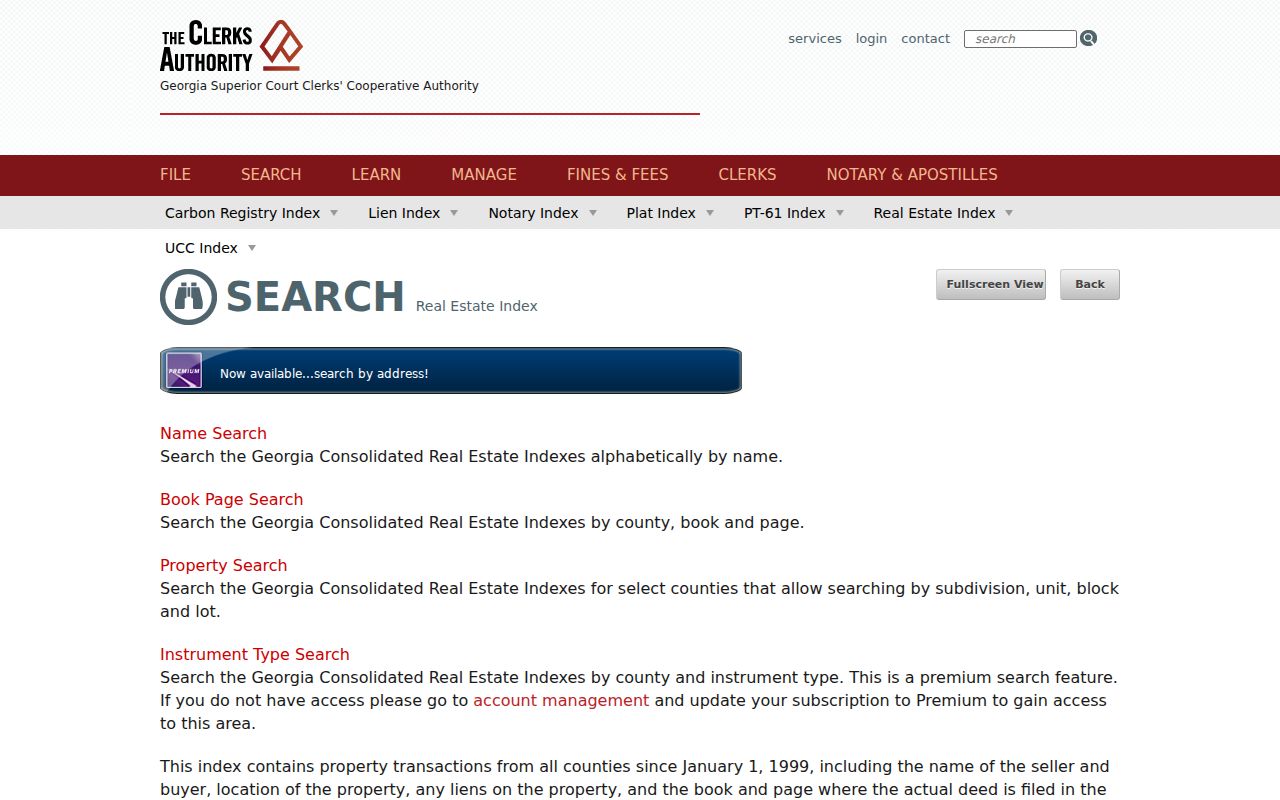
The statewide gateway lets you select Jefferson County. Verify every result against the instrument itself. Fiduciaries, lenders, estates, and correction deeds all complicate the results, and occupancy evidence should stay separate from title evidence.
Search Jefferson County's Older Place Names
Historic deeds often describe roads, creeks, rail lines, acreage, or adjoining owners instead of a modern street name. Wadley was once Shakerag. Both names belong in deed, plat, and newspaper searches. Wrens clues include Cason Creek, US 1, and Shady Oaks, while Wadley offers Railroad, Spier, Lincoln Park, Freeman, and Washington. Each is a lead, never proof of ownership.
Reconstruct the Jefferson County Deed Chain Backward
The backward method is disciplined repetition. Search the latest grantee, open the matching conveyance, use its grantor as the next name, and confirm the same land every time.
- Find the newest matching deed and record its grantor.
- Search that grantor as a grantee in an earlier acquisition.
- Match the legal description, acreage, and cited references.
- Switch to courthouse volumes or microfilm when online coverage ends.
- Grantor / grantee
- The conveying and receiving roles.
- Chain of title
- The ordered sequence of matched transfers.
- Legal description
- The land description that survives address changes.
Bridge Jefferson County's 1861 Record Loss
A reported 1861 loss can sever an early chain. Never invent the missing transfer. Triangulate instead with tax digests, probate records, plats, newspaper legal notices, Justice Court material, and neighboring-county records, stating plainly what each source proves.
The Georgia Archives tax collection and county microfilm cards help locate older evidence. A tax entry is a clue, not a deed.
Use Jefferson County Probate as a Past-Owner Bridge
A will, petition, letters, court order, or fiduciary deed may explain why a surname drops out of the ordinary sequence. Follow the probate authority through to a recorded executor's or administrator's deed when one exists. That recorded deed is the title link. A death certificate supplies event evidence but transfers no land.
Confirm Jefferson County Historic Clues in Instruments
The News and Farmer and Wadley Herald digital run covers 1875 through 1967 and may surface sales or old place names. Historical Society maps and manuscripts can orient a tract. Use them to build search terms. Confirm each former owner in recorded conveyances. Note whether an item is an original, transcript, index card, microfilm image, or database entry.
Know How Far Jefferson County Ownership Records Reach
Jefferson County's exact earliest online GSCCCA year is not published. Ask the Clerk or GSCCCA for the current online span. For earlier former owners, use courthouse deed books, Georgia Archives microfilm, the Virtual Vault, and relevant FamilySearch catalog entries.
Coverage limit. Jefferson County's online cutoff is unpublished. State the gap and never smooth an incomplete chain into certainty.
A good log records the date, grantor, grantee, deed type, book/page, source, property match, and any unresolved issue. Use past-owner data for lawful research, never to harass anyone. House history, estate, boundary, and purchase research all fit.
Search Both Sides of Jefferson County's Deed Index
A former-owner chain usually needs both grantor and grantee directions. Begin with the newest deed. Search its grantor as a grantee to find that party's earlier acquisition. Then search the same name as grantor. That search may surface correction deeds, quitclaims, easements, or later transfers that explain the record. Spelling variants, initials, entity suffixes, and fiduciary terms all matter. Do not join two results until the land description agrees.
GSCCCA also offers separate plat, lien, PT-61, and UCC routes. A plat cross-reference can stabilize an old lot-and-block description. A PT-61 adds transfer context. A lien or security deed may explain why a name appears without representing a fee-title transfer. So save each record type in its own column. That keeps the ownership timeline from treating every indexed document as a sale.
Continue the Jefferson County Chain at the Clerk's Counter
The Jefferson County Clerk of Superior Court keeps deeds, plats, liens, UCC filings, and related real-estate instruments. Public research is available at 202 E Broad Street in Louisville, during posted Monday through Friday hours of 8:30 a.m. to 5 p.m. When the online chain stops, the counter takes over. Bring the last confirmed grantee, an approximate year, a book/page reference, the parcel, and the legal description. Ask which earlier deed book continues that name.
Ordinary copies cost $1 per page. Certified copies run $2.50 for the first page plus $.50 for each later page. Confirm charges and payment terms before ordering. This is the route for a certified deed. An archive image or newspaper notice may guide the search but never becomes a certified county deed.
Build a Jefferson County Archive Research Log
Start the log with the tract itself. Record the county's predecessor boundary. Note the owner or tract name. Add the tax district, the acreage, and a nearby road or watercourse. Note the format of each source too. Georgia Archives material may arrive as an original. It may also arrive as a transcript, an index card, or a microfilm image. The Virtual Vault county-card and tax collections help you pick the right series. The Historical Society catalog adds maps, letters, ledgers, and manuscripts to the mix.
Digitized newspapers earn their keep with legal-sale notices and alternate place names. Record the issue date and the property wording. Then go back to the deed or probate evidence. When the 1861 loss blocks a complete chain, say so plainly. State the last confirmed owner, the first later confirmed owner, and every source you examined. An honest gap beats a guessed former owner every time.
Tax digests test whether a surname and a tract stayed linked across the years. Changes in district, acreage, or adjoining-owner wording still need explaining. A historic plat may name the subdivision and its original lots. Probate papers can surface heirs or a fiduciary. Newspaper notices may expose a judicial or tax sale. None of these should quietly stand in for a deed. In the log, tag every source by its role. The roles are conveyance evidence, administrative evidence, geographic evidence, and contextual clue.
A well-built request gets better archive help. Give the current legal description and the last confirmed old description. Include both owner-name directions and the years you want. Mention the reported 1861 loss. Then ask which deed book, tax digest, probate series, or county microfilm card might bridge it. That framing lets the custodian route the search without promising a missing instrument survived. Keep the archive identifier and retrieval date with every response.